


AI is rapidly changing how customers discover products, compare services, and make purchasing decisions. By 2027, AI recommendations are expected to become an increasingly important part of the customer journey, moving beyond simple “customers who bought this also bought” suggestions toward intelligent, context-aware recommendations based on customer intent, behavior, preferences, location, and real-time interactions.
For businesses in Lahore, Pakistan, this shift creates an important opportunity. Companies that start building AI-ready customer data, websites, content, product information, and conversion systems now can be better positioned to benefit as AI-driven discovery becomes more common.
At DMT Lahore, we see AI recommendations as part of a broader transformation in digital marketing: businesses will increasingly need to make their information understandable not only to search engines, but also to AI systems that help customers decide what to buy and where to buy it.
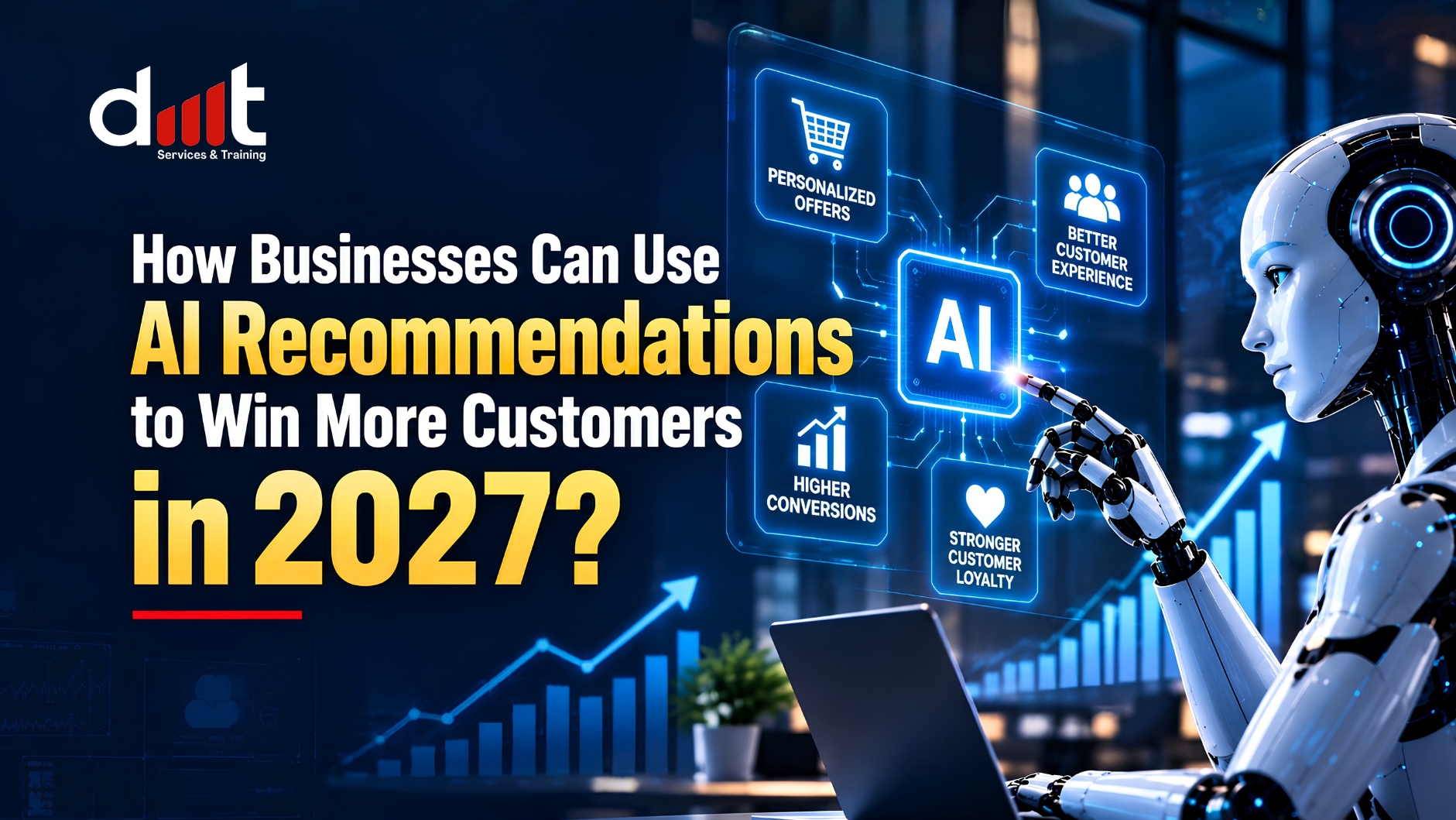
What Are AI Recommendations?
AI recommendations are personalized suggestions generated by artificial intelligence based on available customer and business data.
Traditional recommendations might use basic rules such as:
- Most popular products
- Recently viewed products
- Related products
- Products purchased together
Modern AI recommendation systems can go much further. They can analyze multiple signals simultaneously, including:
- Search behavior
- Purchase history
- Website interactions
- Customer preferences
- Product attributes
- Location
- Price sensitivity
- Previous conversations
- Content engagement
- Seasonal trends
- Customer intent
- Real-time behavior
Instead of simply asking, “What product is related to this product?”, an AI system can attempt to answer a more valuable question:
“What is the most relevant product, service, or solution for this particular customer right now?”
That distinction can significantly change how businesses approach sales and marketing.
Why AI Recommendations Will Matter More in 2027
Customer expectations are moving toward personalization. People increasingly expect digital experiences to understand their needs rather than showing identical content to everyone.
For example, an ecommerce website selling electronics could show the same smartphone to every visitor. An AI-powered system, however, could potentially recognize different customer intents.
- A customer looking for a budget phone may receive recommendations based on price and battery life.
- A gaming customer may see devices emphasizing processor performance, RAM, and display refresh rate.
- A business customer may see models selected according to productivity, security, and battery performance.
The underlying catalog remains the same, but the recommendation logic changes according to customer intent.
This creates an opportunity for businesses to improve several stages of the funnel:
Discovery → Consideration → Recommendation → Conversion → Retention
AI recommendations can potentially influence each stage.
- Build First-Party Customer Data
The foundation of effective AI recommendations is quality data.
Businesses should not think of AI simply as a tool they install on a website. AI becomes much more useful when it has access to structured, relevant, and trustworthy business data.
A company should begin collecting first-party signals such as:
- Products viewed
- Categories visited
- Search queries
- Add-to-cart actions
- Purchases
- Lead submissions
- Previous customer interactions
- Content engagement
- Preferred price ranges
- Repeat purchases
- Customer lifecycle stage
For example, suppose a Lahore-based clothing store identifies that a customer repeatedly views formal wear but rarely interacts with casual products.
An AI recommendation system can use this behavioral signal to prioritize formal clothing, accessories, and related products rather than displaying random products.
The important technical principle is data quality before model complexity.
A sophisticated recommendation model trained on poor or inconsistent data can produce poor recommendations.
- Create Structured Product and Service Data
Businesses should make their product and service information highly structured.
This is particularly important as AI systems increasingly process information from websites, databases, feeds, and other digital sources.
For ecommerce businesses, product data should clearly define:
- Product name
- Brand
- Category
- Price
- Availability
- Features
- Specifications
- Variants
- Images
- Reviews
- Shipping information
- Return policy
- Related products
For service businesses, the equivalent information might include:
- Service category
- Target customer
- Location
- Pricing model
- Features
- Benefits
- Service area
- Process
- Requirements
- FAQs
- Case studies
- Customer reviews
A business in Lahore offering SEO services, for example, should clearly communicate whether it provides local SEO, technical SEO, Google Maps optimization, ecommerce SEO, SEO content, GEO, or other specialized services.
This makes the business information easier to understand, classify, compare, and potentially recommend.
- Use AI to Understand Customer Intent
Keyword targeting alone is not enough for advanced AI-driven marketing.
Businesses should begin thinking about intent classification.
Consider these searches:
“best AC for small room”
“AC installation Lahore”
“energy efficient inverter AC”
Although all three relate to air conditioning, their commercial intent is different.
An AI system can potentially classify these users into different intent groups:
Research intent:
The customer is learning about available options.
Commercial investigation:
The customer is comparing products or services.
Transactional intent:
The customer is ready to purchase.
Local service intent:
The customer wants a provider in a specific location.
This allows businesses to deliver more appropriate recommendations.
For example, a user still researching may receive educational content, while a high-intent visitor may receive product comparisons, pricing, availability, or a direct consultation option.
- Use AI Recommendations for Services, Not Just Products
AI recommendations are not limited to ecommerce.
Service-based businesses can also benefit.
Consider a digital marketing agency in Lahore.
A visitor may interact with pages about:
- SEO
- Google Ads
- Social media marketing
- Website development
- AI video production
Instead of presenting the same contact message to every visitor, the website could recommend a service based on observed behavior.
For example:
Visitor A: Mostly reads SEO content → recommend an SEO consultation.
Visitor B: Views Google Ads services and pricing → recommend a Google Ads strategy session.
Visitor C: Reads ecommerce website content → recommend an ecommerce development package.
This creates a more intelligent lead-generation funnel.
- Make Recommendations Context-Aware
One of the biggest opportunities in 2027 will be contextual recommendations.
The same customer may need different recommendations at different times.
For example, a customer may search for:
“office chairs in Lahore”
during the working week and later search for:
“ergonomic chair for home office.”
The customer’s context has changed.
A modern recommendation system can potentially combine:
- Previous behavior
- Current query
- Device
- Location
- Time
- Product availability
- Price
- Customer profile
The objective is not simply personalization.
It is contextual relevance.
- Optimize Content for AI Discovery
AI recommendations will also influence how businesses approach SEO and content marketing.
Businesses should create content that clearly answers customer questions and demonstrates expertise.
For DMT Lahore, this means businesses should consider content structures such as:
- Detailed service pages
- Product comparison pages
- Expert guides
- FAQs
- Case studies
- Local service pages
- Pricing explanations
- How-to articles
- Product specifications
- Customer reviews
- Author and company information
Content should be factual, useful, well-structured, and aligned with genuine customer needs.
The objective is not to manipulate AI systems.
The objective is to make business information clear, reliable, comprehensive, and machine-readable.
- Use Recommendation Systems in WhatsApp and Chatbots
In Pakistan, messaging platforms are particularly important for lead generation and customer communication.
Businesses can integrate AI into conversational experiences to help customers discover relevant products or services.
For example:
Customer:
“I need digital marketing for my business in Lahore.”
An AI assistant could ask:
- What type of business do you operate?
- Do you need leads or ecommerce sales?
- What services are currently running?
- What is your approximate advertising budget?
It could then recommend the most relevant service package.
This is significantly more useful than sending a generic brochure to every lead.
AI Recommendations and Local Businesses in Lahore
For businesses operating in Lahore, Pakistan, local context can be particularly valuable.
A recommendation system may need to consider:
- Location
- Service area
- Delivery availability
- Local pricing
- Business hours
- Customer reviews
- Google Business Profile information
- Local demand
- Language preferences
- Product availability
A restaurant, clinic, training institute, real estate company, ecommerce store, or digital marketing agency can all benefit from better local data.
For example, a customer searching for SEO training in Lahore should ideally receive information that clearly explains location, course structure, training format, schedule, experience, and relevant services.
The more complete and accurate the information, the easier it becomes for digital systems—and customers—to understand the business.
How DMT Lahore Can Help Businesses Prepare for 2027
At DMT Lahore, we believe businesses should begin preparing for AI-driven marketing before it becomes mainstream.
A strong AI-ready digital strategy can include:
- SEO
- GEO and AI search optimization
- Website optimization
- Structured content
- Local SEO
- Google Business Profile optimization
- Social media marketing
- Google Ads
- AI-generated video content
- Conversion optimization
- Analytics
- Lead-generation systems
The objective is to create a digital ecosystem where customers can easily discover, understand, evaluate, and contact a business.
AI recommendations will not replace strong marketing fundamentals. Instead, they will make data quality, content quality, technical SEO, customer experience, and conversion optimization even more important.
Frequently Asked Questions
- What are AI recommendations in digital marketing?
AI recommendations use artificial intelligence and customer data to identify and suggest products, services, content, or actions that may be relevant to an individual customer based on behavior, preferences, intent, and context.
- Can small businesses in Lahore use AI recommendations?
Yes. Small businesses can start with relatively simple solutions such as personalized website content, AI chatbots, product recommendations, CRM automation, and customer segmentation before investing in advanced machine-learning recommendation systems.
- How can AI recommendations increase sales?
AI recommendations can improve relevance throughout the customer journey. By presenting products, services, content, or offers that better match customer intent, businesses may increase engagement, conversions, average order value, repeat purchases, and customer retention.
- Do AI recommendations replace SEO?
No. SEO remains important because search engines and AI-driven discovery systems need reliable, structured, relevant information. Strong technical SEO, useful content, local SEO, and website authority can support a business’s visibility across traditional and AI-powered discovery channels.
- How should businesses prepare for AI-driven sales in 2027?
Businesses should start by improving first-party data collection, website structure, content quality, product and service information, analytics, CRM integration, SEO, local visibility, and conversion tracking. They should then test AI-powered personalization and recommendations based on measurable business objectives.