

Google Search is moving beyond traditional blue links toward conversational, AI-driven experiences. For ecommerce businesses, this change creates a new opportunity: customers can now describe what they want in natural language, compare products, ask follow-up questions, and move closer to purchase without relying on short, exact-match keywords.
Google has been expanding shopping capabilities inside AI Mode, including conversational shopping experiences and new AI-powered advertising formats. Google has also stated that AI-driven shopping experiences depend heavily on the quality of product data supplied through Merchant Center.
For ecommerce businesses in Lahore, Pakistan, this means traditional SEO and Google Ads strategies need to evolve. The objective is no longer simply to rank for “buy shoes online.” Businesses need to make their product data, website content, structured data, Merchant Center feed, landing pages, conversion signals, and advertising assets understandable to Google’s AI systems.
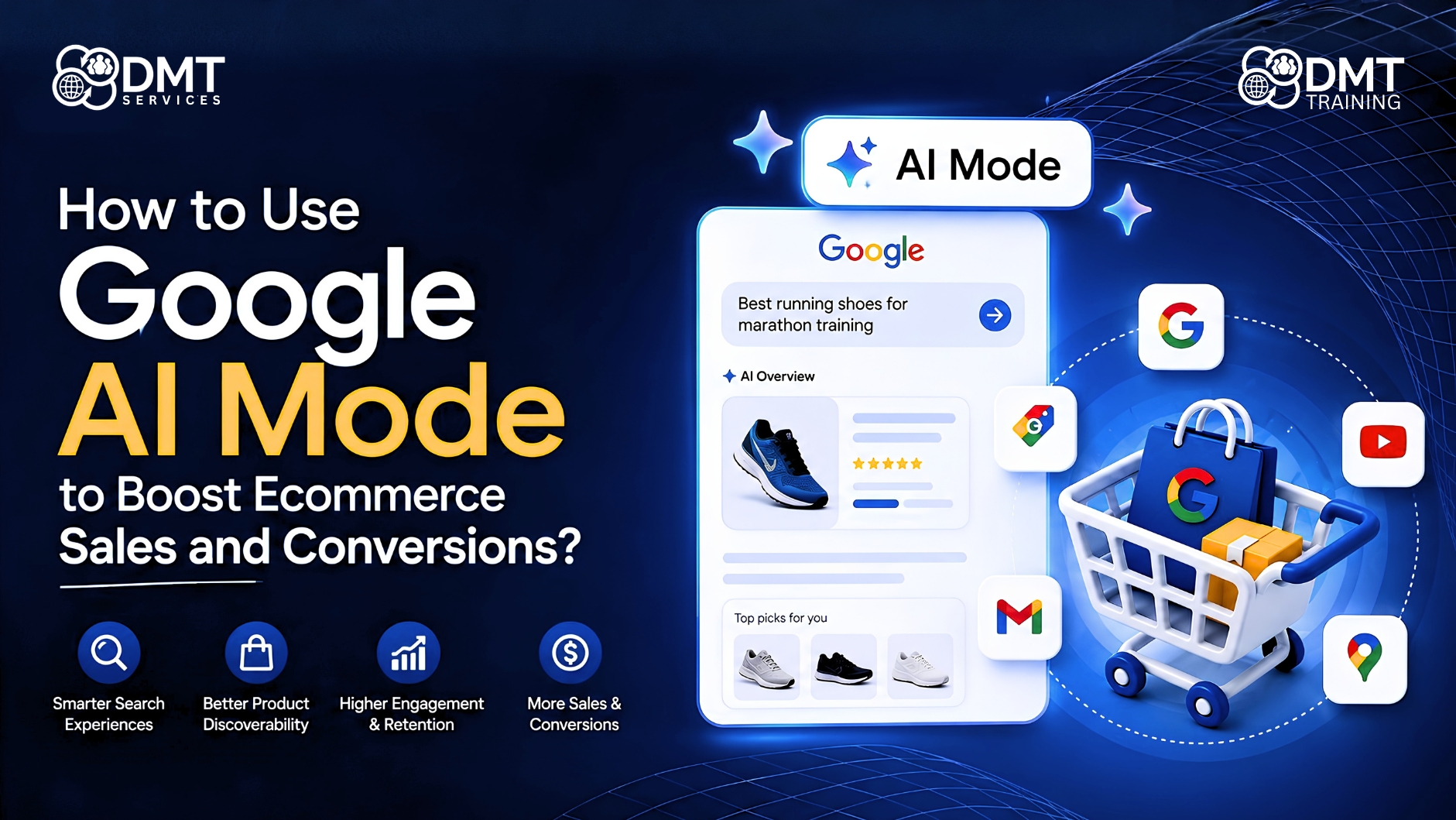
What Is Google AI Mode?
Google AI Mode is a more conversational Search experience designed to answer complex questions and help users explore topics through follow-up queries. Instead of performing several independent searches, a customer can ask a detailed question and refine the conversation.
For example, a shopper might search:
“I need comfortable running shoes under PKR 20,000 for daily jogging in Lahore. Which options have good cushioning and are available locally?”
This is fundamentally different from:
“running shoes Lahore”
The first query contains budget, location, use case, product characteristics, and purchase intent.
Google’s AI-powered shopping experiences are designed to understand these more complex shopping journeys. Google’s current AI performance reporting also categorizes conversational shopping behavior into discovery, evaluation, and purchase phases. For ecommerce marketers, this creates a new optimization framework.
- Build a High-Quality Google Merchant Center Feed
Your Merchant Center product feed is one of the most important technical assets for ecommerce visibility.
Google uses product information such as images, titles, prices, and store information to determine where relevant product ads can appear. Shopping ads rely heavily on submitted product data rather than conventional keyword targeting alone.
Your feed should contain accurate:
- Product title
- Brand
- Product type
- Category
- Description
- Price
- Availability
- Condition
- GTIN where applicable
- MPN where applicable
- Product URL
- Main image
- Additional images
- Shipping information
- Product attributes
Avoid generic titles such as:
“Running Shoes”
Instead, create descriptive titles:
“Nike Air Zoom Pegasus 41 Men’s Running Shoes – Black/White”
The second title provides Google’s systems with significantly more semantic information.
- Optimize Product Titles for Semantic Search
Traditional SEO often focuses heavily on keyword placement. AI-driven shopping requires a broader approach.
Your product title should communicate:
Brand + Product + Model + Key Attribute + Variant + Intended Use
For example:
Samsung Galaxy S25 Ultra 256GB Titanium Black – Unlocked Smartphone
is more informative than:
Samsung S25 Ultra Price
Do not stuff keywords into titles. Instead, provide structured, factual information that helps Google’s systems understand exactly what the product is.
- Write Product Descriptions for Conversational Queries
AI Mode can interpret longer and more complex shopping questions. Therefore, product descriptions should answer the questions customers naturally ask.
Instead of:
“Premium leather office chair with adjustable height.”
Use a more comprehensive description:
“This ergonomic leather office chair is designed for professionals who spend long hours working at a desk. It features adjustable seat height, lumbar support, padded armrests, and a reclining backrest. It is suitable for home offices, corporate workplaces, and study rooms.”
The second description provides more entities, attributes, use cases, and contextual relationships.
This gives search systems more information to associate the product with relevant conversational searches.
- Use Structured Data Correctly
Technical SEO remains extremely important.
Implement relevant schema markup such as:
- Product
- Offer
- AggregateRating
- Review
- BreadcrumbList
- Organization
- WebSite
Product structured data should accurately reflect information visible on the page.
Important fields can include:
- Product name
- Image
- Description
- Brand
- SKU
- GTIN
- Price
- Currency
- Availability
- Aggregate rating
- Review count
Do not use schema markup to communicate information that does not actually exist on the webpage.
For advanced ecommerce implementations, synchronize the following three data layers:
Website Product Data → Structured Data → Merchant Center Feed
When these systems contain conflicting prices, availability, titles, or product attributes, data quality can suffer.
- Create Content Around Shopping Intent
Ecommerce SEO should not stop at product pages.
Build supporting content around the entire buying journey.
Discovery Content
Examples:
- Best Running Shoes for Beginners
- Best Laptops for Students
- Best Air Conditioners for Large Rooms
Evaluation Content
Examples:
- Nike Pegasus vs Adidas Ultraboost
- 1.5 Ton vs 2 Ton AC
- SSD vs HDD for Business Laptops
Purchase Content
Examples:
- Nike Pegasus 41 Price in Pakistan
- Buy 1.5 Ton Inverter AC in Lahore
- Laptop Under PKR 150,000 in Pakistan
This creates a topic-to-product architecture connecting informational searches with commercial landing pages.
- Optimize for Product Comparisons
AI shopping journeys naturally involve comparison.
Customers frequently ask:
- Which product is better?
- Which one offers better value?
- Which model is suitable for my budget?
- Which product has lower maintenance costs?
- Which product is better for Pakistani weather?
- Which option has better warranty coverage?
Create comparison pages that provide factual, structured information.
A useful comparison table can include:
| Feature | Product A | Product B |
| Price | PKR 120,000 | PKR 135,000 |
| Warranty | 1 Year | 2 Years |
| Capacity | 1.5 Ton | 1.5 Ton |
| Energy Rating | 5 Star | 4 Star |
| Availability | In Stock | In Stock |
This format makes product differences easy for both users and search systems to understand.
- Connect Google Ads With Merchant Center
For paid ecommerce campaigns, connect your Google Ads account with Merchant Center.
Google currently supports Performance Max campaigns using Merchant Center product data, allowing Google’s systems to use product information and campaign inputs to optimize advertising performance. Your setup should include:
Website → Merchant Center → Google Ads → Conversion Tracking → Analytics
Make sure conversion tracking measures meaningful ecommerce actions such as:
- Purchase
- Add to Cart
- Begin Checkout
- Product View
- Qualified Lead
Do not optimize exclusively for clicks.
The real objective is profitable conversions.
- Prepare for AI-Powered Advertising Formats
Google is actively developing advertising formats specifically for AI-driven Search experiences.
In 2026, Google announced testing of new AI-era ad formats, including conversational advertising experiences and AI-powered shopping ads. These formats are designed to provide product guidance and relevant information within increasingly conversational Search experiences.
This means advertisers should prepare their campaigns now rather than waiting for AI Mode advertising to become fully mature.
A strong foundation includes:
- Clean Merchant Center data
- Accurate product availability
- High-quality images
- Strong product pages
- Reliable conversion tracking
- Clear pricing
- Competitive offers
- Strong customer reviews
- Appropriate campaign structures
- Improve Product Images
Visual search and AI shopping make product imagery increasingly important.
Use:
- High-resolution product photography
- Multiple product angles
- Clean backgrounds
- Lifestyle images
- Product-in-use images
- Close-up detail shots
- Correct image dimensions
- Descriptive image filenames
For example:
nike-air-zoom-pegasus-41-black.jpg
is preferable to:
IMG_8372.jpg
Images should also be compressed without visibly damaging quality.
- Strengthen Reviews and Trust Signals
AI-driven recommendations do not eliminate the importance of trust.
Build strong ecommerce trust signals through:
- Genuine customer reviews
- Verified purchases
- Product ratings
- Warranty information
- Return policies
- Shipping information
- Business contact details
- Physical business address
- Secure payment options
- Customer support
For businesses serving Lahore and Pakistan, clearly communicate delivery areas, payment methods, return conditions, warranty coverage, and local support.
- Optimize Landing Pages for Conversion
Driving AI-driven traffic is only half the job.
Your landing page must convert that traffic.
A strong product page should include:
Above the fold
- Product name
- Product image
- Price
- Availability
- Primary CTA
Product information
- Benefits
- Specifications
- Features
- FAQs
- Reviews
Trust
- Warranty
- Returns
- Delivery
- Secure payment
Conversion
- Add to Cart
- Buy Now
- Contact support
The page should also be fast and mobile-friendly because ecommerce traffic increasingly comes from smartphones.
- Implement Advanced Conversion Tracking
For advanced ecommerce campaigns, use Google Tag Manager and GA4 to implement reliable event tracking.
Track events such as:
view_item
add_to_cart
begin_checkout
add_payment_info
purchase
generate_lead
For each purchase, pass relevant parameters such as:
- Transaction ID
- Revenue
- Currency
- Product ID
- Product name
- Quantity
- Product category
This creates better first-party measurement and gives advertising platforms stronger conversion signals.
- Use First-Party Data
As privacy restrictions increase, ecommerce businesses should build their own customer data ecosystem.
Useful first-party signals include:
- Customer email
- Purchase history
- Product interests
- Repeat purchases
- Customer lifetime value
- Cart abandonment
- Previous product interactions
Where legally appropriate and with proper consent, these signals can help improve remarketing and customer segmentation.
- Build an AI Search Optimization Dashboard
Advanced ecommerce teams should monitor more than traditional rankings.
Track:
- Organic traffic
- Shopping traffic
- Product impressions
- Merchant Center issues
- Product disapprovals
- Conversion rate
- Revenue
- ROAS
- Average order value
- Add-to-cart rate
- AI-related visibility where available
Google has introduced AI performance insights in Merchant Center that can provide visibility into how brands are discovered across AI Mode and AI Overviews. However, Google notes that the current report is focused on organic AI traffic and does not include paid Ads traffic. Therefore, marketers should not assume that AI visibility reports represent total AI advertising performance.
- Focus on the Entire Shopping Journey
The biggest strategic mistake is treating AI Mode as another keyword-ranking channel.
Instead, think in terms of:
Discovery → Evaluation → Comparison → Purchase → Retention
For example:
Discovery:
“Best smartphones under PKR 100,000”
↓
Evaluation:
“Which Samsung phone has the best camera under PKR 100,000?”
↓
Comparison:
“Samsung A56 vs Xiaomi model X”
↓
Purchase:
“Where can I buy Samsung A56 in Lahore?”
↓
Retention:
“Samsung A56 accessories and warranty”
Your SEO, content, Merchant Center feed, paid advertising, and website should support every stage.
Google AI Mode Strategy for Ecommerce Businesses in Lahore
For ecommerce businesses operating in Lahore, DMT Lahore recommends combining technical SEO, Google Merchant Center optimization, structured data, high-quality product content, Google Ads, conversion tracking, and local commercial signals.
For example, an ecommerce business selling electronics in Lahore could optimize for:
- Product availability in Lahore
- Same-day or next-day delivery
- Local pickup
- PKR pricing
- Warranty information
- Payment methods
- Product specifications
- Customer reviews
- Local business information
Instead of targeting only:
“buy laptop Lahore”
the business should build content and product data capable of answering:
“What is the best laptop under PKR 150,000 for a graphic designer in Lahore with at least 16GB RAM and an SSD?”
This is the type of detailed commercial intent that modern AI-powered search experiences are increasingly designed to understand.
Common Mistakes to Avoid
Avoid these problems:
- Incomplete Merchant Center product data
- Incorrect product prices
- Out-of-stock products marked as available
- Duplicate product URLs
- Poor-quality images
- Missing structured data
- Keyword-stuffed product titles
- Thin product descriptions
- Slow mobile pages
- Poor conversion tracking
- Fake or manipulated reviews
- Unsupported claims
- Ignoring product comparisons
- Focusing only on traditional keyword rankings
Frequently Asked Questions
- Can ecommerce businesses advertise directly inside Google AI Mode?
Google is actively introducing and testing new advertising formats for AI-powered Search experiences, including shopping-related and conversational formats. Availability and formats can vary by market and rollout stage.
- Is Google Merchant Center important for AI Mode ecommerce visibility?
Yes. Merchant Center provides critical product information used across Google’s shopping ecosystem. Google specifically states that AI-driven shopping experiences are powered by the product data retailers provide.
- Does traditional SEO still matter with Google AI Mode?
Absolutely. Technical SEO, authoritative content, structured data, product-page quality, website performance, and trustworthy information remain important foundations. AI Mode should be treated as an evolution of the search experience rather than a replacement for SEO.
- What should ecommerce businesses in Pakistan optimize first?
Start with Merchant Center feed quality, product pages, structured data, mobile performance, conversion tracking, product images, reviews, and Google Ads configuration. These foundations should be corrected before investing heavily in advanced AI advertising strategies.
- How can DMT Lahore help with Google AI Mode ecommerce marketing?
DMT Lahore can help ecommerce businesses with technical SEO, ecommerce SEO, Google Merchant Center, Google Ads, conversion tracking, product-feed optimization, content strategy, and AI-focused search optimization, creating an integrated strategy designed to increase qualified traffic, conversions, and revenue.