


Keyword cannibalization is one of the most overlooked SEO problems that can prevent a website from reaching its full ranking potential. It happens when multiple pages on the same website target the same or very similar search intent, causing Google to struggle to determine which page should rank for a particular keyword.
For businesses in Lahore, Pakistan, this issue can become especially important when competing for local searches such as SEO services in Lahore, digital marketing services in Lahore, web development, social media marketing, and other location-based keywords. Publishing more pages does not automatically mean getting more Google rankings. If several pages compete for the same search intent, your website may spread its authority across multiple URLs instead of building strong relevance around one primary page.
In this guide, DMT Lahore explains what keyword cannibalization is, how to identify it, why it affects Google rankings, and how to fix it without unnecessarily deleting valuable content.
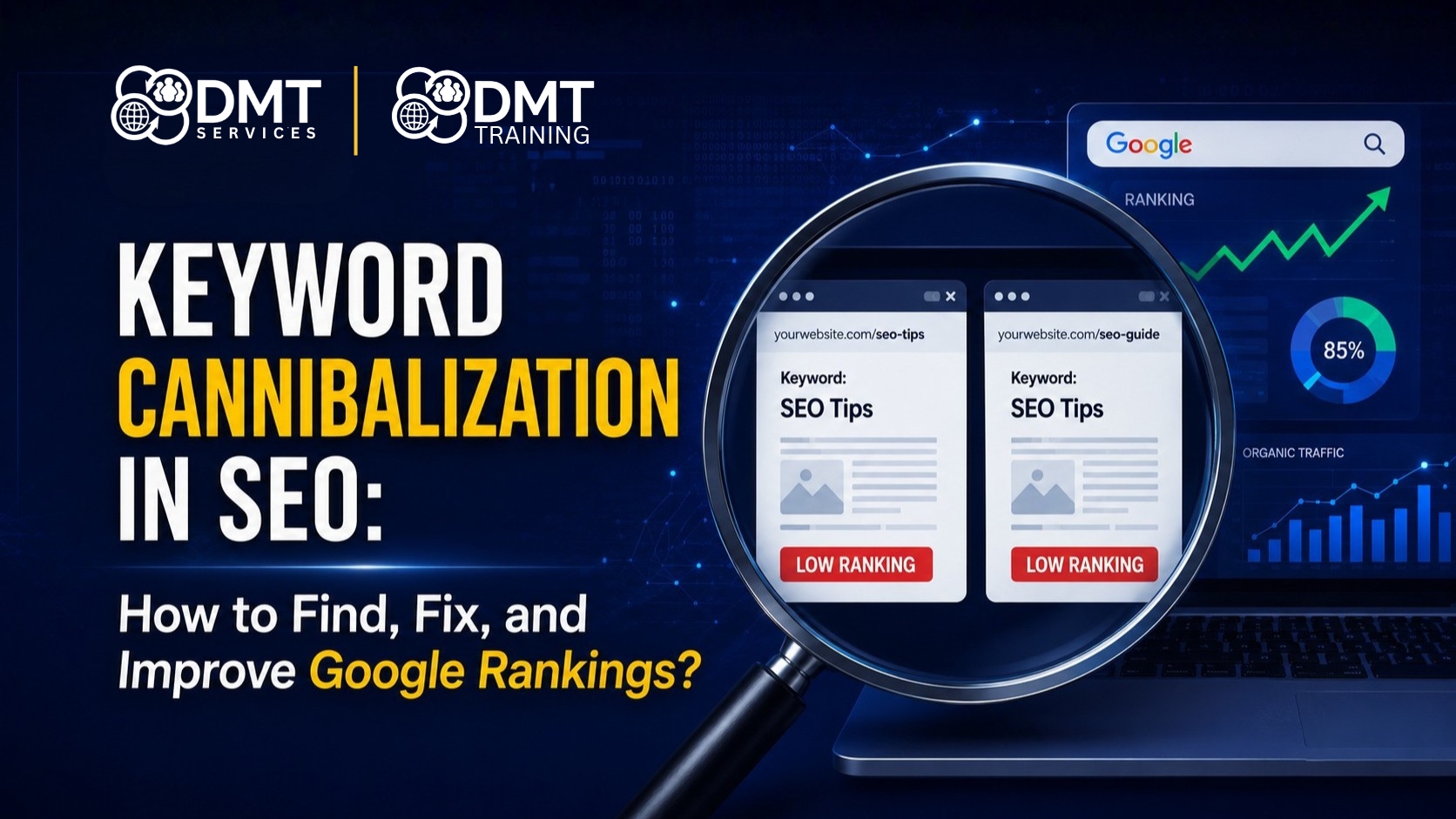
What Is Keyword Cannibalization in SEO?
Keyword cannibalization occurs when two or more pages on your website target the same keyword, closely related keywords, or the same search intent.
For example, imagine a digital marketing website has these pages:
- SEO Services in Lahore
- Best SEO Services in Lahore
- Professional SEO Services Lahore
- SEO Company in Lahore
- Affordable SEO Services Lahore
If all five pages provide almost the same information and target the same audience, Google may have difficulty deciding which URL deserves to rank.
This does not mean that simply using the same keyword on multiple pages always creates a cannibalization problem. A website can naturally mention the same keyword across several pages. The real problem occurs when multiple URLs have similar content, overlapping keyword targeting, and the same search intent.
A Simple Example
Suppose your website has two pages:
Page A: SEO Services in Lahore
Page B: SEO Company in Lahore
If Page A is designed to explain SEO services and Page B is a genuine company landing page with unique information, different content, and a different search intent, they may coexist successfully.
However, if both pages contain almost identical content and attempt to rank for the same searches, they may compete with each other.
The solution is not always to delete one page. The right solution depends on the purpose, authority, content quality, backlinks, rankings, and search intent of each URL.
Why Keyword Cannibalization Matters for Google Rankings
Google wants to show the most relevant result for a user’s search. When multiple pages from the same website are competing for similar queries, Google may select different URLs at different times.
This can create several SEO problems.
- Your Rankings May Become Unstable
One page may rank on page one today while another URL appears tomorrow. This can make your organic visibility inconsistent.
Instead of building strong authority around one page, ranking signals may become distributed among several URLs.
- Link Equity Can Be Divided
If backlinks point to different pages targeting similar topics, the authority that could have strengthened one important URL may be distributed across several URLs.
Internal links can create a similar problem if they point to multiple competing pages using the same anchor text.
- Google May Rank the Wrong Page
One of the most frustrating cannibalization problems is when Google ranks a page that you did not intend to use as your main landing page.
For example, you may want your main SEO services in Lahore page to rank, but Google may instead show an old blog post that briefly discusses SEO services.
The issue may be caused by differences in relevance, internal linking, content depth, backlinks, or search intent.
- Click-Through Rates Can Suffer
If Google displays a less relevant URL, users may not find exactly what they are looking for.
A poorly optimized page can receive impressions but fewer clicks, reducing the overall performance of your organic search strategy.
- SEO Efforts Become Less Efficient
Creating, updating, and building links for several pages that target the same topic can waste time and resources.
A better strategy is often to identify the strongest URL and improve it instead of creating additional pages that compete with it.
Common Causes of Keyword Cannibalization
Keyword cannibalization can happen naturally as a website grows.
Publishing Too Many Similar Blog Posts
Businesses often publish multiple articles around closely related topics without establishing clear keyword targeting.
For example:
- How to Improve SEO
- SEO Tips for Better Rankings
- Best SEO Techniques
- How to Increase Google Rankings
- SEO Strategies for Businesses
These topics can be valuable individually, but if the articles target nearly identical queries and provide overlapping information, they may compete with one another.
Creating Multiple Location Pages
Local businesses sometimes create dozens of city or area pages with almost identical content.
For a Lahore-based business, creating pages for different areas can be useful when each page serves a genuine local audience. However, simply replacing the location name while keeping the same content can create thin or repetitive pages.
A good location page should provide useful, locally relevant information rather than simply repeating the same template.
Product and Service Page Overlap
A business may create separate pages for:
- SEO Services
- SEO Packages
- Professional SEO
- SEO Consultation
- SEO Agency
If these pages all target the same search intent, they should be reviewed carefully.
Poor Internal Linking
Internal links help search engines understand the structure and importance of your website.
If several pages repeatedly use the same anchor text and point to different URLs, Google may receive unclear signals about which page should be considered the primary resource.
How to Find Keyword Cannibalization
Finding cannibalization requires more than simply searching your keyword on Google.
Here are practical methods you can use.
- Use Google Search Console
Google Search Console is one of the most useful tools for identifying keyword overlap.
Open the Performance report and review:
- Search queries
- Clicks
- Impressions
- Average position
- Pages
Select an important keyword and check which URLs are receiving impressions or clicks for that query.
If several URLs consistently appear for the same keyword, investigate whether they are competing for the same search intent.
What Should You Look For?
Pay attention to situations where:
- Two pages rank for the same primary keyword.
- Rankings frequently switch between URLs.
- An unexpected blog post ranks instead of your main service page.
- Multiple URLs receive impressions for similar queries.
- Several pages have very similar titles and content.
Not every instance requires a fix. Search intent should always be considered before making changes.
- Perform a Google Search
Use Google to examine which pages are appearing for your target keywords.
Search for your main keyword and review your site’s results.
You can also use:
site:yourwebsite.com keyword
For example:
site:example.com SEO services Lahore
This can help you discover which pages Google associates with the topic.
Compare the pages and ask:
- Do they target the same audience?
- Do they answer the same question?
- Do they offer the same service?
- Are the titles similar?
- Is the content substantially overlapping?
- Do they have similar calls to action?
If the answer is yes to most of these questions, further investigation is recommended.
- Create a Keyword Mapping Spreadsheet
Keyword mapping is one of the most effective ways to prevent cannibalization.
Create a spreadsheet containing:
| URL | Primary Keyword | Secondary Keywords | Search Intent | Current Ranking | Action |
| /seo-services-lahore/ | SEO services in Lahore | SEO agency Lahore | Commercial | — | Keep |
| /seo-guide/ | SEO guide | SEO basics | Informational | — | Keep |
| /seo-packages/ | SEO packages Lahore | SEO pricing | Commercial | — | Review |
The purpose is to give every important page a clear SEO role.
One keyword does not necessarily need one URL. Instead, focus on assigning one primary search intent to the most appropriate page.
- Analyze Page Titles and Headings
Review the title tags and H1 headings of your pages.
If five pages have titles such as:
- SEO Services in Lahore
- Best SEO Services in Lahore
- Professional SEO Services in Lahore
- Affordable SEO Services in Lahore
- Expert SEO Services in Lahore
you should investigate whether those pages actually serve different purposes.
If they do not, consolidation may be a better strategy.
- Compare Search Intent
Search intent is more important than exact keyword matching.
Consider these searches:
SEO services in Lahore
This generally has commercial or transactional intent.
What is SEO?
This is informational.
SEO services price in Lahore
This has commercial research intent.
These queries are related but may deserve different pages.
A website can rank multiple pages around the same topic when each page provides a genuinely different and useful answer.
How to Fix Keyword Cannibalization
Once you identify a cannibalization problem, choose the solution based on the condition of the pages.
- Consolidate Similar Pages
If two or more pages serve essentially the same purpose, consider combining them into one comprehensive resource.
For example, if you have:
- SEO Services Lahore
- Professional SEO Services Lahore
- Best SEO Services Lahore
and they all contain similar information, consolidate the strongest content into one authoritative page.
The remaining URLs can be redirected to the preferred page when appropriate.
This allows ranking signals to become more concentrated.
- Use 301 Redirects When Appropriate
A 301 redirect permanently moves users and search engines from one URL to another.
If Page B is redundant and Page A is the stronger, preferred page, a 301 redirect can help consolidate the old URL into the new one.
Before redirecting, check:
- Organic traffic
- Backlinks
- Rankings
- Conversions
- Content quality
- Historical value
- Search intent
Do not redirect a valuable page simply because it shares a keyword with another URL.
- Improve Internal Linking
Internal linking can help clarify which page is your primary resource.
For example, if your main page targets SEO services in Lahore, relevant blog posts can naturally link to that page with descriptive anchor text.
Your internal linking structure should make it clear which page is the primary commercial resource and which pages support it.
Avoid forcing the exact same anchor text into every internal link. Use natural variations where appropriate.
- Differentiate Search Intent
Sometimes you do not need to merge pages.
Instead, make each page serve a different purpose.
For example:
Main Service Page
SEO Services in Lahore
Focus on:
- Services
- Benefits
- Process
- Pricing information
- Local expertise
- FAQs
- Contact or consultation
Informational Article
How Does SEO Work for Businesses in Lahore?
Focus on:
- SEO fundamentals
- Search visibility
- Keyword research
- Technical SEO
- Content
- Local SEO
Pricing Article
SEO Services Pricing in Lahore
Focus on:
- Pricing factors
- SEO packages
- Monthly costs
- Deliverables
- Factors affecting pricing
This structure gives each page a distinct purpose.
- Optimize Existing Content Instead of Creating More Pages
One common SEO mistake is creating a new article whenever rankings decline.
Before publishing another article, check whether an existing page already targets the topic.
If an existing page has:
- backlinks,
- organic traffic,
- impressions,
- rankings,
- strong internal links,
- useful content,
it may be better to update and improve that page.
Content optimization can include:
- Updating outdated information
- Improving headings
- Adding useful examples
- Expanding missing sections
- Improving internal links
- Adding relevant FAQs
- Improving title and meta description
- Strengthening topical relevance
- Use Canonical Tags Correctly
A canonical tag tells search engines which URL you consider the preferred version when similar or duplicate pages exist.
Canonicalization can be useful in situations involving:
- Similar URLs
- Duplicate versions
- Parameterized URLs
- Product variations
- Tracking URLs
However, canonical tags should not be treated as a universal solution for keyword cannibalization.
If two pages have completely different purposes and both deserve to appear in search results, choosing a canonical URL simply to force one page to rank may not be appropriate.
- Remove or Noindex Low-Value Pages When Necessary
Some pages may have little value and no meaningful search demand.
Examples can include:
- Thin pages
- Duplicate pages
- Outdated campaign pages
- Empty tag pages
- Low-value archive pages
Depending on the situation, you may consider improving, redirecting, consolidating, or removing them.
Do not automatically noindex pages just because they receive little traffic. Some pages may support users, conversions, internal linking, or other business objectives.
Keyword Cannibalization and Local SEO in Lahore
Local SEO requires special attention because businesses often create multiple location-focused pages.
For example, a Lahore digital marketing business may target:
- SEO services in Lahore
- Digital marketing services in Lahore
- SEO services in Johar Town
- SEO services in Wapda Town
- SEO services near Bahria Town Lahore
- Local SEO services Lahore
These keywords are related, but they do not necessarily require separate pages.
The important question is whether each page provides unique local value.
A strong local landing page could include:
- Local service information
- Areas served
- Customer needs in that area
- Service details
- Location-specific FAQs
- Genuine business information
- Relevant internal links
- Clear contact information
Avoid creating dozens of nearly identical pages simply by changing the neighborhood name.
For a business such as DMT Lahore, the goal should be to build a clear website architecture where the primary service pages, course pages, location pages, and educational content each have a defined purpose.
How to Prevent Keyword Cannibalization
Prevention is easier than fixing a large website with hundreds of competing URLs.
Build a Keyword Map Before Publishing
Before creating a new article, check your existing content.
Ask:
Do I already have a page targeting this topic?
If yes, determine whether the new content should:
- Update the existing page
- Expand an existing page
- Target a narrower search intent
- Target a different audience
- Become a supporting article
Assign One Primary Topic to Each Important Page
Every major page should have a clear purpose.
For example:
- Homepage → Digital marketing training
- SEO service page → SEO services
- Blog article → SEO education
- Course page → SEO training
- Pricing page → Course or service pricing
- Location page → Local audience
This structure reduces unnecessary overlap.
Keyword Cannibalization Audit Checklist
Use this checklist during a regular SEO audit:
- Export your important ranking keywords.
- Identify multiple URLs ranking for the same query.
- Review Google Search Console performance data.
- Compare page titles and H1 headings.
- Compare content and topics.
- Analyze search intent.
- Check internal links.
- Review backlinks to competing URLs.
- Identify the strongest URL.
- Consolidate genuinely overlapping pages.
- Use 301 redirects where appropriate.
- Improve internal linking.
- Differentiate search intent when pages should remain separate.
- Review canonical tags where relevant.
- Monitor rankings after making changes.
How Long Does It Take to Recover From Cannibalization?
There is no fixed recovery period.
After making SEO changes, Google needs time to recrawl and reassess the affected pages.
The timeframe can depend on:
- Website size
- Crawl frequency
- Number of URLs
- Strength of the domain
- Quality of the content
- Internal linking
- Redirect implementation
- Backlink profile
- Overall SEO health
After making significant changes, monitor Google Search Console and organic rankings rather than expecting immediate results.
Frequently Asked Questions
- What is keyword cannibalization in SEO?
Keyword cannibalization occurs when multiple pages on the same website target the same or very similar keywords and search intent. This can make it harder to determine which page should rank for a particular search.
- Does keyword cannibalization always hurt Google rankings?
No. Having multiple pages rank for related keywords is not automatically a problem. Cannibalization becomes a concern when pages compete for the same search intent, rankings fluctuate, or an unwanted URL ranks instead of your preferred page.
- How can I find keyword cannibalization?
You can use Google Search Console to identify multiple URLs receiving impressions or clicks for the same queries. You can also perform site searches, review keyword rankings, compare page content, and create a keyword mapping spreadsheet.
- Should I delete pages that have keyword cannibalization?
Not necessarily. Depending on the situation, you may consolidate content, improve search intent differentiation, update the page, redirect a redundant URL, or keep both pages if they serve different purposes. Always evaluate traffic, backlinks, rankings, conversions, and content value before deleting a page.
- How can I prevent keyword cannibalization in the future?
Create a keyword map before publishing new content, assign a clear primary topic and search intent to each important page, avoid publishing repetitive articles, maintain a logical internal linking structure, and regularly audit Google Search Console data.